

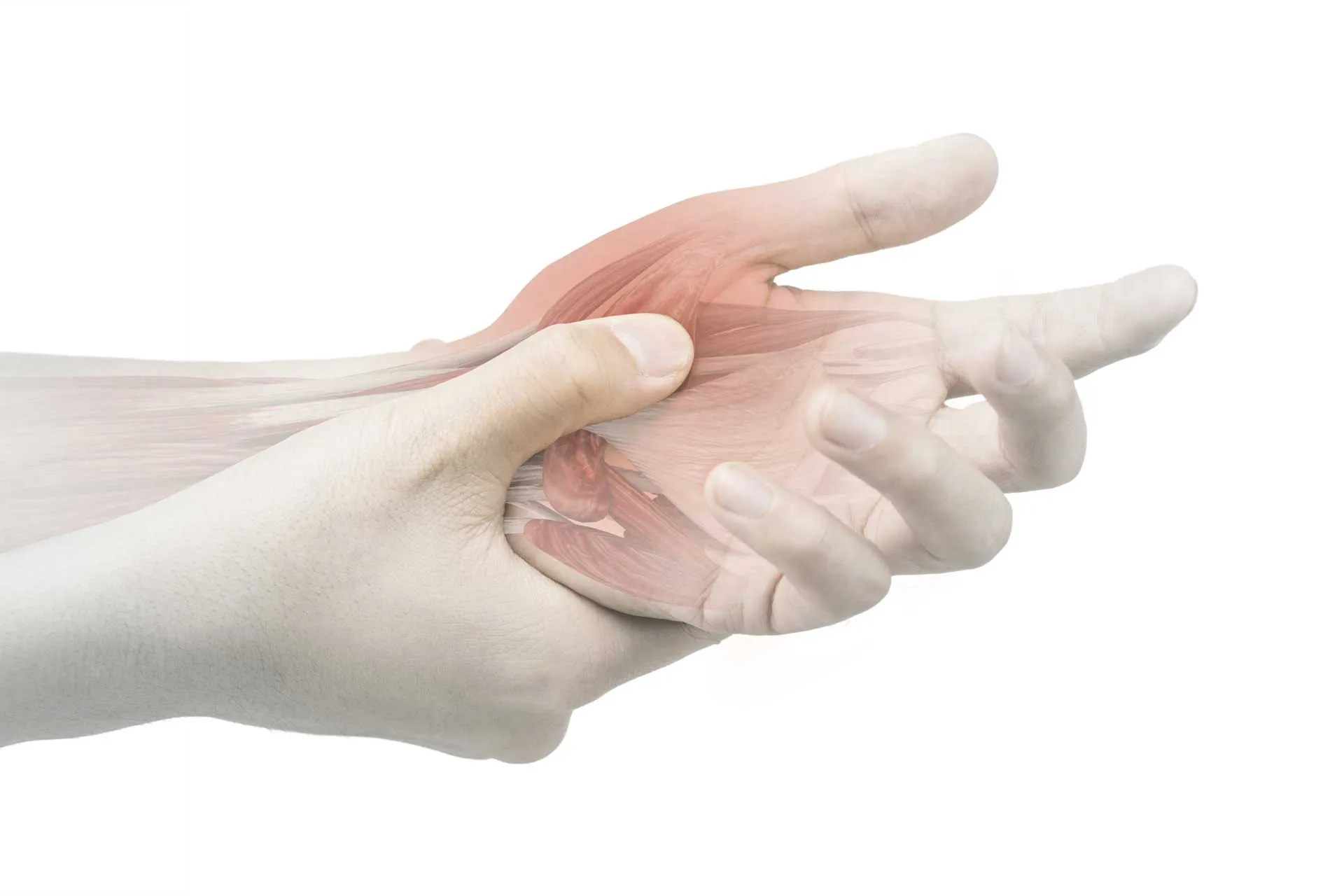
Treatment Spectrum

Hand surgery.
A domain of outpatient care.

Surgical procedures on the hands are a domain of outpatient surgery. They can almost always be performed under local or regional anaesthesia (arm only). Patients are not confined to bed and have little pain to fear after the procedure.

We have been performing these operations successfully for more than 15 years, with rising numbers. The total has now reached around 250 operations per year — not counting minor procedures on fingers or hand injuries.

In the operating theatre Outpatient under regional anaesthesia —
precise, gentle, in familiar surroundings.
Treatment process

From the first consultation
to a free hand

Five clear steps — always with the same doctor, from diagnosis to suture removal. That preserves trust and ensures no detail is lost.

Pre-operative consultation

Clinical examination, careful diagnosis and detailed information about the planned procedure. We discuss all your questions at leisure.

Preparation

You arrive with an empty stomach (for general anaesthesia) or as normal (for local anaesthesia). Admission, changing, brief preparation in the operating suite.

Operation

Under local or regional anaesthesia — you remain awake but feel nothing. Depending on the diagnosis, the procedure takes 15 to 45 minutes.

Recovery room

Brief monitoring in our recovery room. As soon as your vital signs are stable and you feel well, you may go home.

Follow-up care

Dressing changes and suture removal at our practice. Mobility and full use of the hand are completely restored after 3–4 weeks.

What we treat

Common
conditions

A selection of the most common indications we see in our consultations — choose a condition to see its cause, symptoms and treatment.

Carpal tunnel syndrome

A "trapped nerve" at the wrist caused by pressure on the median nerve (nervus medianus).

Cause
The carpal bones and a ligament stretched across them form a narrow channel at the wrist for the median nerve. The exact cause of the compression is unknown — manual work, injuries and pregnancy are considered contributing factors.
Symptoms
CTS initially makes itself felt at night: pain in the fingers, radiating up to the elbow, plus numbness of the thumb, index and middle fingers. Later, difficulty gripping, loss of strength and wasting of the thumb-ball muscles follow.
Treatment
Non-surgical treatments offer no lasting success. Surgical treatment delivers very good results: through a 3–4 cm skin incision, the carpal ligament is divided (open technique), relieving pressure on the nerve and freeing it from adhesions. The complication rate is well below 1%.

Dupuytren's disease

Nodular cords in the palm that cause progressive bending of individual fingers.

Cause
A connective tissue disorder of the palm. Palpable and visible nodules develop gradually — first in the palm, later on the fingers. The ring and little fingers are most commonly affected.
Symptoms
Progressive shortening of the cords causes the fingers to bend more and more. A "hook finger" with complete loss of function can develop.
Treatment
Ultrasound, cortisone injections and laser treatment have no scientific evidence of benefit. Only surgical treatment promises success — required when one or more fingers can no longer be fully straightened (extension deficit of 20° or more). Where nodules are very painful, earlier surgery can also be worthwhile.

Ganglion cyst

A gel-filled cyst on the wrist or fingers — usually harmless, sometimes bothersome.

Cause
A ganglion is an outpouching of the joint capsule or a tendon sheath, filled with gel-like fluid. Often follows overuse — occasionally appears without any identifiable trigger.
Symptoms
A visible, firm-elastic bulge — usually on the back of the wrist. May press on nerves and can cause pain or restricted movement.
Treatment
If symptomatic, surgical removal under local anaesthesia — we remove the cyst and its stalk completely to minimise recurrence.

Tendon injuries

Ruptures or severed flexor and extensor tendons — usually after cuts or sports injuries.

Cause
Cuts, sports accidents (e.g. "mallet finger"), more rarely degenerative ruptures after previous illness or with rheumatic disease.
Symptoms
Sudden loss of function in a finger — bending or straightening becomes difficult or impossible. Visible drooping of the fingertip joints.
Treatment
Fresh tendon injuries should be repaired microsurgically as quickly as possible (within days). This is followed by consistent occupational therapy — crucial for the outcome.

Thumb base arthritis · Heberden's

Osteoarthritis of the thumb base joint or the finger end joints — a common cause of painful hands.

Cause
Wear of the cartilage in the thumb base joint (rhizarthrosis) or finger end joints (Heberden's nodes). Genetic predisposition and years of strain play a role.
Symptoms
Pain on gripping (opening a jar, turning a key), tenderness, later visible swelling and restricted movement.
Treatment
Conservative treatment with a splint, ointment and physiotherapy. With advanced wear, surgery — from resection arthroplasty to fusion of individual joints.

Trigger finger

Painful snapping when bending — a thickening of the flexor tendon catches on the pulley ligament.

Cause
A nodular thickening of the flexor tendon catches on the pulley ligament. With more forceful bending it releases with a jerk — the snapping is painful.
Symptoms
Individual fingers "stick" in the morning and release with a jerk. In advanced stages the finger stays bent and has to be straightened with the other hand.
Treatment
A brief outpatient procedure under local anaesthesia: division of the pulley ligament — the tendon glides freely again. Full use restored after 2–3 weeks.
Frequently asked questions

What you
should know

Answers to the questions our patients ask most often. Can't find your question? Write to us via medflex.

For procedures under local or regional anaesthesia you may eat and drink normally — you remain awake during the operation and need no preparation as for general anaesthesia. We discuss the details in the pre-operative consultation.
During the operation you are pain-free thanks to the local or regional anaesthesia — the arm becomes temporarily numb. Significant pain after surgery is also rare; if needed, you will receive a mild painkiller.
That depends on the procedure and your job. Carpal tunnel: usually 1–2 weeks for office work, 4–6 weeks for manual work. Considerably longer after tendon surgery. We issue your sick note on an individual basis.
Not on the day of surgery. Please arrange an accompanying person for the journey home — either family/friends or a taxi. Once the dressing is small enough and full feeling has returned to the arm, you are fit to drive again.
Mobility and full use of the hand are usually completely restored after 3–4 weeks. Sport and heavy physical work should pause until then — lighter activities are often possible sooner.
All medically necessary hand surgery procedures are fully covered by statutory and private health insurers. For workplace or commuting accidents we bill the Berufsgenossenschaft (BG, German statutory accident insurance) directly.

Contact & Directions

Write to us

Secure and without an app — via our medflex channel.

For urgent matters, you can reach us by phone on 09661 80336, weekdays 07:30–18:00.

Enquiry via medflex

Our consultation hours

Mon · Tue · Thu08:00 – 13:00 / 15:00 – 18:00 Wed08:00 – 13:00 Fri07:30 – 13:00 / 15:00 – 17:00 Sat09:00 – 11:00

Emergencies are seen throughout the day on weekdays — please give us a quick call so we can fit you in.

Where to find us

MVZ Sulzbach-Rosenberg
Obere Gartenstraße 13 A
92237 Sulzbach-Rosenberg

Google Maps